
Thin lines, deliberate detail, and a lightness that holds up close. Fine line work is drawn for the body it's going on — never traced from a template.
20+ Years • Private Studio • By Appointment
Fine line tattooing is defined by line weight. Where a traditional tattoo builds depth through thick outlines and heavy shading, fine line work keeps the needle narrow — often a single consistent weight from start to finish — and uses spacing, not ink density, to create the image.
That restraint is the whole appeal. A well-executed fine line tattoo looks drawn rather than stamped: airy, precise, and legible at close range. It's the reason the style has become the default choice for botanical pieces, small script, single-subject motifs, and delicate detail that would otherwise disappear inside a heavy outline.
It also demands more from the artist than it appears to. Thin lines show hesitation. There's no room to correct a wobble with more ink, so the drawing has to be right before the needle ever touches skin — and the design has to account for how the body moves underneath it.
At Inkspirations, fine line work is never treated as a quick add-on. Melissa draws each piece at the scale it will actually be tattooed, then adjusts line weight and detail level to match the placement.
Consistent line weight — usually a single thin gauge throughout the design.
Minimal or no heavy shading — negative space does the work.
Precision over scale — detail stays fine instead of being enlarged.
High contrast on skin — reads cleanly against a bare background.
Drawn to placement — composed for the specific spot, not resized from a flat image.
These are directions clients often come in with — starting points for a conversation, not a catalogue of designs waiting to be picked. Every piece is redrawn from scratch.
Stems, leaves, and single blooms rendered in outline. Fine line lets a floral piece stay open and airy rather than filling the whole area with solid color.
Names, dates, phrases, and script. Lettering is the least forgiving form of fine line work — size and body placement matter more here than anywhere else.
Constellations, coordinates, initials, heirlooms, personal iconography. Small, private references that don't need to explain themselves to anyone else.
A single continuous line, a simple geometric mark, or a figure reduced to its essentials. Restraint is the entire point.
Pets and wildlife outlined, often with internal detailing. A silhouette filled with pattern rather than shaded flat.
Most fine line tattoos start as an idea rather than a style. If you're not sure it translates, that's exactly what the consultation is for.
Fine line tattoos live or die on the drawing. Here's how a reference image becomes a piece that actually belongs on your body.
You send your concept, the placement, an approximate size, and any reference images. References are treated as direction — the mood, the subject, the feeling — not as a file to copy.
You and Melissa discuss what the piece should carry — the story behind it, what you'd change, what has to stay. Placement and scale get settled here, because they shape the drawing.
Once the $80 deposit is received, design work begins. You'll get a preview of your stencil before the appointment. Changes need to be requested at least three days ahead.
A few pieces from the studio that show how fine line work reads on skin. More, including larger and colour pieces, is in the full portfolio.
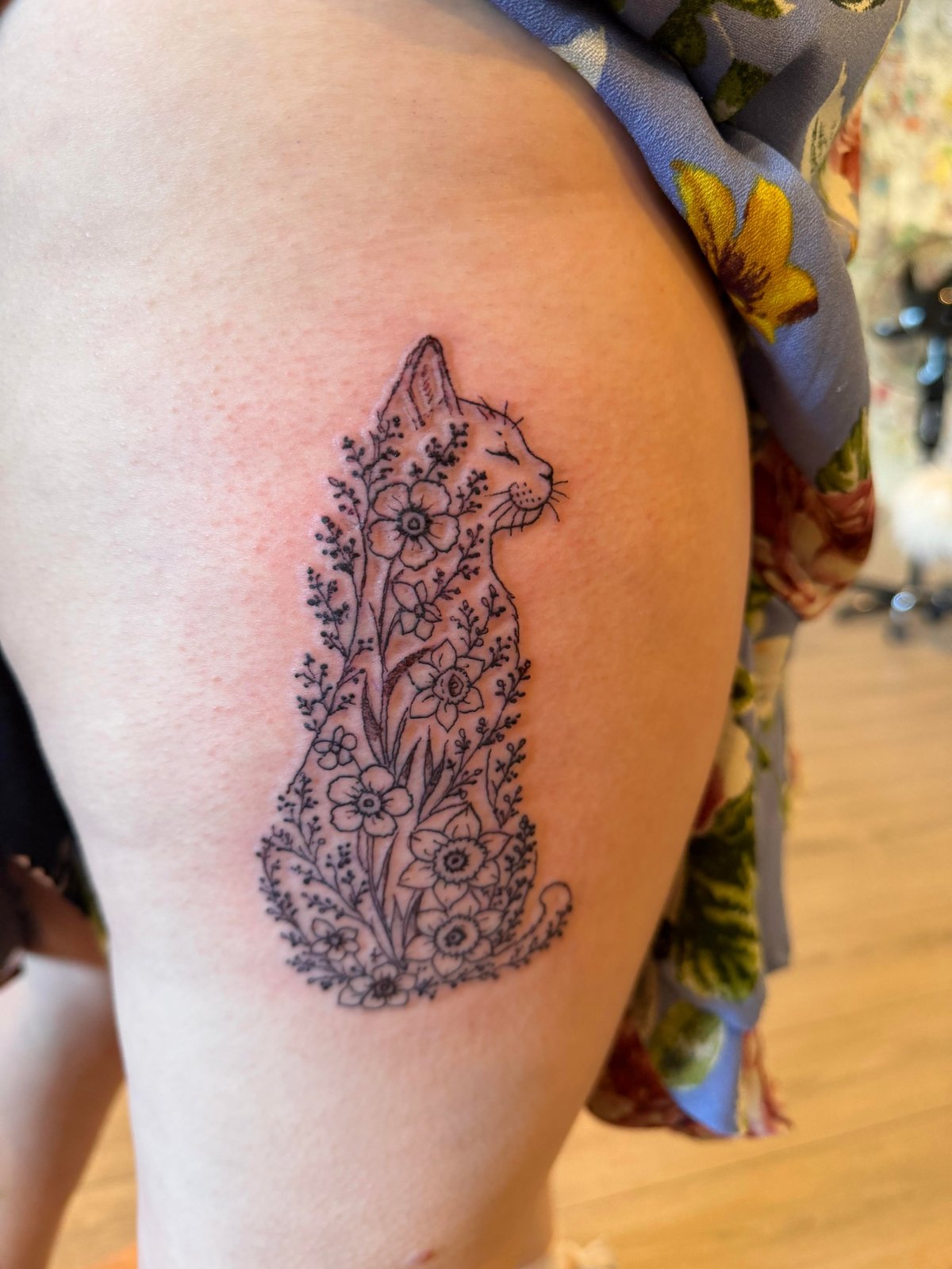
Botanical silhouette — outline work filled with floral line detail
Also working in ornamental, illustrative, geometric, Japanese-inspired, and anime styles.
The most common mismatch in fine line tattooing isn't style — it's scale. A design that works beautifully at six inches can turn to mush at two, and the fix isn't more ink. It's either a larger piece or a simplified drawing.
Fine detail needs room. Inside a small area, thin lines sit close enough together that they blend as they heal. Melissa will tell you honestly when a design is asking for more space than the placement gives it, and what to adjust instead.
Line weight has a floor. There's a practical minimum for detail before it stops holding its shape.
Flat surfaces read cleanest. Forearms, inner biceps, thighs, and ribs hold fine detail better than areas that crease, flex, or see constant friction.
Hands, feet, and fingers are harder. High-friction spots can fade faster regardless of how the tattoo is done.
Compose for the body. The drawing should follow the limb, not sit on it like a sticker.
A fresh fine line tattoo is deceptive. It looks settled within days because there's so little surface disruption — but the skin is still healing underneath for several weeks, and the ink is still settling into the dermis.
Melissa provides detailed aftercare instructions at your appointment. In general terms: keep the area clean, avoid soaking it in baths or swimming pools, keep it out of direct sun while it heals, don't pick or scratch, and don't let anyone else touch it. Proper aftercare is what protects the detail you paid for.
Over years, very fine detail may soften. Skin changes with sun exposure, age, and weight shifts, and no artist can promise a tattoo will look identical a decade on. What can be done is designing with that in mind — choosing a line weight and level of detail that has room to age instead of collapsing. Sun protection is the single biggest factor, and it's largely in your hands.
An honest note: fine line work is not the best fit for every idea, and you'll be told if a design would be better served by a different line weight. That conversation happens before anything is drawn.
Aftercare QuestionsThe best starting point is a description of what you have in mind, where you want it, and any reference images you've saved. Melissa will take it from there.